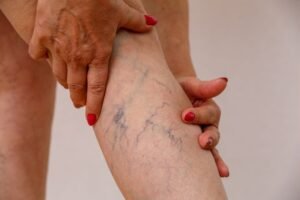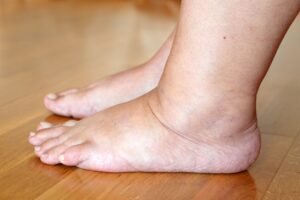

Sitting still for hours raises your risk of a blood clot in the legs. Doctors call this travel related thrombosis. It can happen on a plane, a train, a bus, or a long car ride.
The risk for most healthy travelers stays low. Simple habits can lower it further. This guide explains why clots form during travel, who faces the highest risk, and how to prevent blood clots in long flights.
Why Long Flights Raise Clot Risk
Your calf muscles act as a pump. Each step squeezes the deep veins and pushes blood back toward the heart. When you sit still for hours, that pump stops working. Blood then moves slowly through the leg veins and can begin to clot.
Several travel conditions add to the problem:
- A cramped seat that presses on the back of your thighs
- Low cabin humidity, which can lead to mild dehydration
- Alcohol or caffeine, which dry you out
- Crossed legs or tight clothing that squeeze the veins
A clot in a deep leg vein is called a deep vein thrombosis (DVT). If part of it breaks loose and travels to the lungs, it becomes a pulmonary embolism. That condition is a medical emergency.
How Big Is the Risk?
Research from the World Health Organization helps put this in perspective. Its WRIGHT project reviewed travel and clot risk in detail.
The findings were clear. Travel lasting more than four hours roughly doubles the risk of a clot. The absolute risk, however, stays low for healthy travelers at about 1 in 6,000 flights over four hours. Risk rises with longer trips and with several flights taken close together.
One more point matters. The risk does not end when you land. It stays somewhat higher for a few weeks afterward.
Who Faces Higher Risk
Most of the risk falls on travelers who already have other risk factors. You may need extra care if you have:
- A past DVT or pulmonary embolism
- A close relative with a history of clots
- An inherited clotting disorder
- Active cancer or recent cancer treatment
- Surgery within the past few weeks, especially on the hip, knee, or abdomen
- Pregnancy, or delivery within the past six weeks
- Use of estrogen based birth control or hormone therapy
- Obesity
- Limited mobility, a cast, or a recent leg injury
- Older age
- Very tall or very short height
If any of these apply, talk with your doctor before a long trip. You may need a personal plan, not general advice.
Simple Steps to Prevent Blood Clots in Long Flights
Move Your Legs Often
Movement is the single most useful habit. Try to stand and walk the aisle every two hours. A single lap of the cabin is enough. Work your calf muscles in your seat whenever you cannot get up:
- Ankle pumps: Point your toes up and down 15 to 20 times.
- Ankle circles: Rotate each foot slowly in both directions.
- Heel and toe raises: Lift your heels, lower them, and lift your toes, keeping your feet flat.
- Knee lifts: Raise one knee toward your chest, lower it, and switch sides.
Repeat these every half hour while you are awake. On a long car trip, stop every two hours and walk for a few minutes.
Drink Enough Water
Dehydration thickens the blood slightly and makes you less likely to move. Drink water regularly throughout the flight. Limit alcohol, and go easy on coffee. Trips to the restroom are not a problem here. They give you one more reason to stand up.

Dress for Circulation
Choose loose, comfortable clothing. Avoid tight waistbands, tight socks, and anything that binds at the knee or groin. Do not sit with your legs crossed for long stretches.
Choose Your Seat Wisely
An aisle seat makes it easier to get up often. If you book a window seat, set a reminder to move. Keep the space under the seat in front of you clear so you can stretch your legs.
Consider Compression Socks
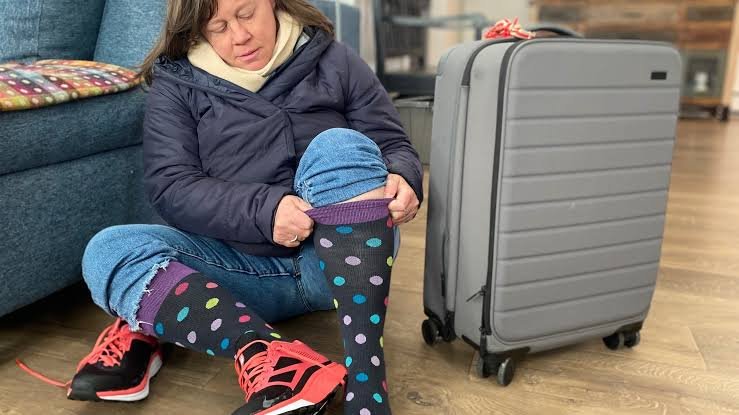
Graduated compression socks squeeze the ankle more firmly than the calf. This helps push blood upward. Research shows they reduce swelling and lower the chance of clots in travelers.
Look for knee high socks that provide about 15 to 30 mmHg at the ankle. Put them on before you leave home. Ask your doctor first if you have peripheral artery disease, diabetes with nerve damage, or fragile skin.
A Checklist Before You Fly
Planning ahead takes only a few minutes:
- Book an aisle seat when you can.
- Pack compression socks in your carry on bag, and put them on before you leave.
- Wear loose clothing and comfortable shoes.
- Fill a water bottle after security.
- Keep medicines in your hand luggage.
- Set a phone reminder to move every half hour.
- Tell your doctor in advance if you have a clot history.
Skip sleeping pills on very long flights unless your doctor advises them. Deep sedation keeps you from shifting position for hours at a time.
What to Do After You Land
Risk does not stop at the gate. Walk through the terminal instead of riding the moving walkway. Stretch your legs once you reach your hotel or home. Drink water and keep moving over the next day or two.
Keep your compression socks on for the rest of travel day if you have risk factors. Pay attention to your legs for the next few weeks, since symptoms can appear well after the trip ends.
What About Aspirin?
Many travelers ask about taking aspirin before a flight. Current guidance does not support it for this purpose. Aspirin works mainly on clots in arteries, not on clots in veins.
Guidelines from chest and vascular specialists advise against aspirin for preventing travel related clots. Never start or stop any medicine on your own. If you face high risk, your doctor may discuss a blood thinner injection instead.
Warning Signs to Watch For
Symptoms may appear on the trip or weeks later. Contact your doctor promptly if you notice signs of a DVT:
- Swelling in one leg, usually the calf
- Pain, cramping, or tenderness in one leg
- Warmth in the affected area
- Skin that looks red, purple, or darker than usual
Call 911 or go to the emergency room if you have signs of a clot in the lungs:
- Sudden shortness of breath
- Chest pain that worsens when you breathe in
- A fast or irregular heartbeat
- Lightheadedness or fainting
- Coughing up blood
Tell the medical team about your recent travel. That detail helps them act quickly.
Planning Ahead for High Risk Travelers
If you have a history of clots, talk with your doctor several weeks before your trip. Your plan may include:
- Properly fitted graduated compression stockings
- A prescription blood thinner before or during travel
- Guidance on timing your current anticoagulant doses
- Advice on breaking a very long trip into shorter segments
Bring a list of your medicines and your doctor’s contact details. Carry your medicines in your hand luggage, not in a checked bag.
Travel With a Known Vein Condition
Varicose veins or past vein treatment raise questions about flying. Mild varicose veins alone do not rule out travel. Your legs may ache more than usual in a seat, and compression socks help with that.
Recent vein treatment is different. Ask your vein specialist how long to wait before a long flight. Many clinics suggest a short waiting period after ablation or sclerotherapy.
People with chronic venous insufficiency should wear their prescribed stockings for the whole trip. Pack a spare pair in your carry on bag. Put the first pair on at home, before any swelling starts.
Tell your doctor about a past blood clot in a vein that was treated. That history places you in the higher risk group, whatever your veins look like today.
Frequently Asked Questions
How long does a flight have to be to raise clot risk?
Research points to about four hours as the threshold. Risk grows with longer flights and with repeat flights in a short period.
Do compression socks really help?
Studies show they lower the risk of clots and reduce leg swelling during long flights. They work best when properly fitted.
Do car and train trips count?
Yes. The risk comes from sitting still, not from flying itself. Any trip over four hours in a seat carries similar risk. Stop and walk every two hours on a road trip.
Should I worry after a short flight?
Short flights carry very little added risk for most people. Move your legs anyway, and know the warning signs.
Can I prevent clots by taking an aspirin?
No. Guidelines advise against aspirin for travel related clot prevention. Ask your doctor what fits your risk level.
The Bottom Line
You can prevent blood clots in long flights with a few steady habits. Move your legs every half hour, stand up when you can, drink water, skip tight clothing, and consider compression socks. Travelers with a clot history or other risk factors need a personal plan from their doctor. Watch for leg swelling or breathing trouble during and after your trip, and seek care right away if symptoms appear.
This article is for general education only. It does not replace advice from your own doctor. Seek emergency care for sudden shortness of breath or chest pain.
Sources
- World Health Organization. WHO Research Into Global Hazards of Travel (WRIGHT) Project: Final Report of Phase I. 2007.
- Centers for Disease Control and Prevention. Blood Clots and Travel: What You Need to Know.
- National Heart, Lung, and Blood Institute. Venous Thromboembolism.
- Clarke MJ, Broderick C, Hopewell S, Juszczak E, Eisinga A. Compression Stockings for Preventing Deep Vein Thrombosis in Airline Passengers. Cochrane Database of Systematic Reviews. 2021.
- Kahn SR, Lim W, Dunn AS, et al. Prevention of VTE in Nonsurgical Patients: Antithrombotic Therapy and Prevention of Thrombosis. Chest. 2012.